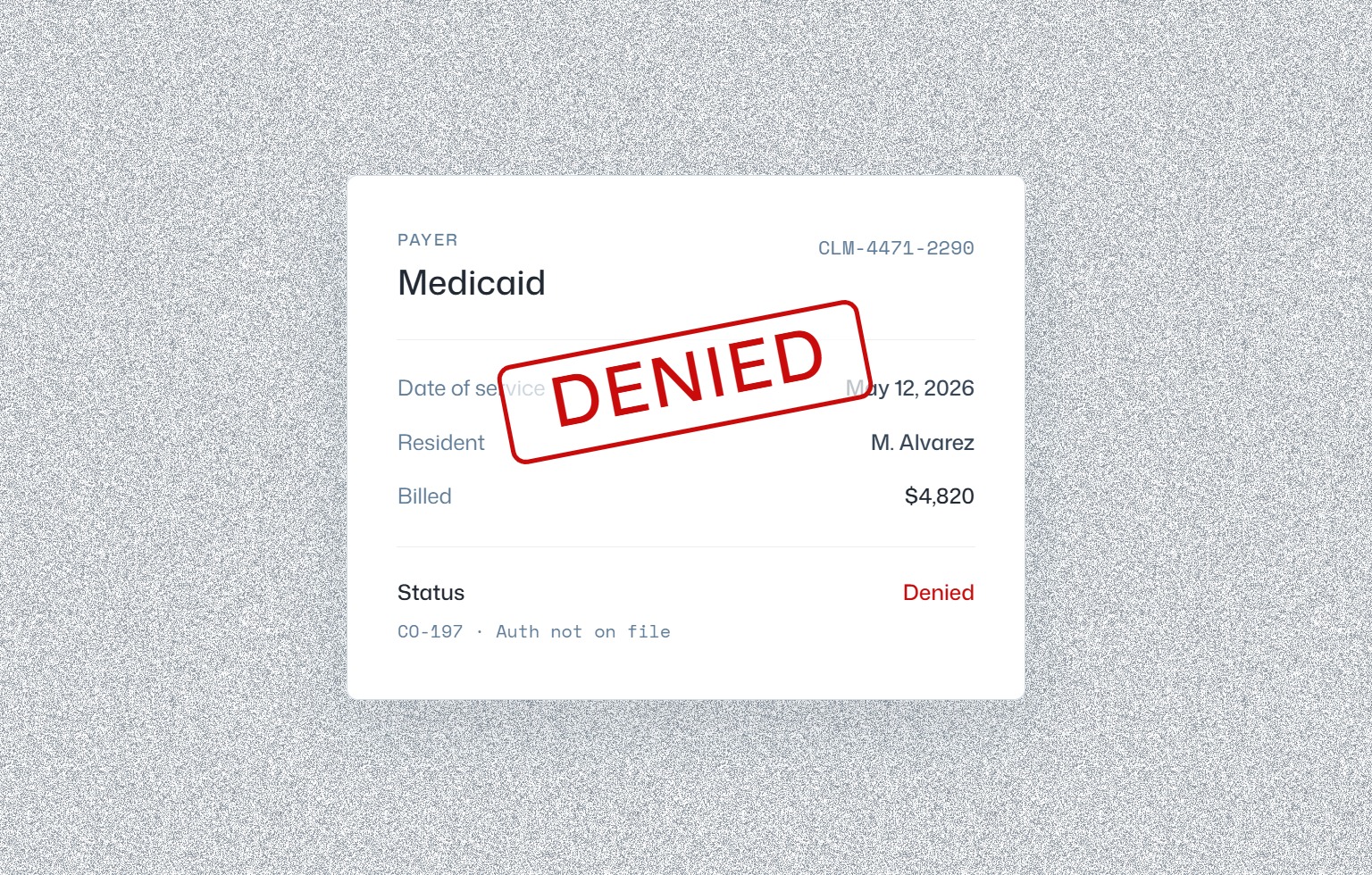

Claims Denial Management: Why Working Denials Isn't Enough
Working denials is recovery. By the time a claim is denied, the money was already lost upstream, in the front-end work that happens before the claim ever goes out.
Ask most skilled nursing operators how they handle denied claims and you'll hear about the back end: someone in the business office reviews the denial, works out why the payer kicked it back, corrects it, and resubmits or appeals. That work is real and necessary. But if it's the whole strategy, the facility is losing revenue it will never fully recover, because denial management as most operators practice it is a recovery function, and recovery is the most expensive, least effective place to fight a denial.
Nothing illustrates this better than what's happening with Medicare Advantage in skilled nursing right now. A 2026 report from the HHS Office of Inspector General found that Medicare Advantage plans denied 12% of requests for skilled nursing admission, with long-stay nursing home residents denied at a rate of 40%. Here's the part that should stop every operator: of the SNF denials that were appealed, 95% were overturned. NaviHealth, the UnitedHealth contractor that processed about half of all these requests, saw 97% of its denials reversed on appeal. An overturn rate that high is a strong signal that most of these denials shouldn't have been issued in the first place. And they were reversed only for the small share of cases anyone bothered to appeal, just 18% of denials.
Consider what that means operationally. The denials are frequently not legitimate, most are never appealed, and the ones that are take days of staff work and delayed cash to overturn. An AHCA survey of 363 nursing home providers found two-thirds are dealing with Medicare Advantage denials or delays every day or every week. A study in Health Affairs put the net revenue hit at 7% of Medicare Advantage revenue, after accounting for what facilities eventually recovered. This isn't a billing-department efficiency problem. It's a structural drain, and working denials harder doesn't fix it.
The plans deserve the scrutiny they're getting. But blaming them, however justified, is itself a reactive posture, and it misses the lever an operator actually controls. Whatever the payer is doing, most denials are set in motion on the provider's own front end, before the claim is ever submitted. That's the part a facility can fix.
Denial management vs. denial prevention
The distinction that matters is between managing denials and preventing them. Managing denials means getting better at appeals, at recovery, at the cleanup after the payer says no. Preventing denials means fixing the upstream breakdowns that generate the denial in the first place. A denial that shows up at adjudication is almost never a billing-department failure. It's the visible end of a chain that started earlier, an eligibility detail that was never confirmed, a prior authorization nobody secured, a level of care that wasn't documented to support the claim, a diagnosis code that no longer maps the way it did last quarter.
This is why "working denials" misses the mark. It treats the denial as the event to manage, when the denial is really just the receipt for a decision made weeks or months earlier. The cost of operating this way compounds. Operators describe it plainly in the trade press: disrupted cash flow, accounts receivable balances that keep climbing, and the staffing cost of chasing delayed or denied claims. One LeadingAge member reported more than $1.5 million in unpaid Medicare Advantage claims at a single point in time. An operator whose entire denial strategy is recovery is getting more efficient at an expensive activity they should be trying to avoid.
The rest of this is about where denials actually originate in skilled nursing, because they start well before the claim reaches the payer.
Where denials start in skilled nursing
Skilled nursing carries the heaviest claims burden in senior living, billing Medicare, Medicaid, and increasingly Medicare Advantage. MA now covers more than half of all Medicare enrollees, and for 99% of them it requires prior authorization for a SNF stay. Most SNF denials trace to a handful of upstream failures, none of which live in the billing office:
- Eligibility and benefit-period verification. A resident's Medicare Part A benefit period, remaining days against the 100-day limit, or qualifying hospital stay isn't confirmed before billing, and the claim is denied for coverage that wasn't actually there. Verifying this on the front end is the single highest-leverage denial-prevention step a SNF has.
- Prior authorization on the Medicare Advantage stay. With prior authorization now near-universal in MA plans, a missed or late authorization means the days get delivered but not paid. Given the denial and delay volume operators are reporting, this is the front-end failure with the largest current dollar impact.
- Level-of-care and skilled-need documentation. SNF payment depends on clinical documentation that substantiates the skilled level of care billed. When the documentation doesn't support it, the claim is denied as not medically necessary even though the care was delivered.
- PDPM coding accuracy. Skilled nursing reimbursement runs on the Patient-Driven Payment Model, where the MDS assessment drives the rate. This is not static: CMS remapped a set of PDPM ICD-10 diagnosis codes effective October 2025, and facilities that kept using the old primary diagnoses started generating automatic denials. Coding that isn't current with the mapping rules produces denials or underpayments on every affected claim.
The through-line: every one of these is set in motion on the front end, when eligibility, authorization, coding, and documentation are, or aren't, nailed down before the claim goes out. By the time it's a denied claim, the window to prevent it has already closed.
Why this is a front-end problem, not a back-office one
Look at where those failures happen and the conclusion is hard to avoid: denials are made upstream, in the front-end of the revenue cycle, and only surface at the back. The eligibility that wasn't verified, the prior authorization that wasn't secured, the benefit period that wasn't confirmed, the coding that didn't match the documentation, these are all decisions that happen when the claim is being set up, before it's ever submitted. The business office that works the denial inherits a problem created earlier in the cycle, and gets measured on a denial rate it didn't generate.
That reframing changes what a facility should invest in. The instinct is to build a better appeals workflow, but that only makes you faster at recovering money you should have collected the first time. Fix the front end instead, verify eligibility, confirm authorization, validate coding, and check the claim against payer rules before submission, and the denial never gets generated. Do that well and the appeals workflow you were about to invest in matters less every quarter, because there's less to appeal. One approach treats the symptom faster. The other removes the cause. It's also why denials are inseparable from revenue integrity: a falling clean-claim rate and a rising denial rate are two readings of the same upstream problem.
What denial prevention actually looks like
Denial prevention isn't a single tool, it's a discipline applied at the front of the revenue cycle, before a claim is submitted. In skilled nursing it comes down to a few things done consistently: verifying eligibility and the Medicare benefit period at the point of billing setup, securing and tracking prior authorization on every Medicare Advantage stay, keeping PDPM diagnosis coding current with the latest mapping rules, and validating each claim against the specific payer's requirements before it goes out rather than after it comes back. The industry's "triple-check" process, reconciling clinical documentation, coding, and coverage before submission, is the manual version of this discipline. The point is to catch what would cause a denial while the claim can still be fixed, not after the payer has already said no.
How Sunbound prevents denials
This front-end discipline is what Sunbound RCM is built to run. Sunbound handles the full skilled nursing revenue cycle in one platform: eligibility and insurance discovery, prior authorization, claim construction and validation, submission, denial management, appeals, and payment posting. Its AI flags what would cause a denial before the claim goes out. It parses authorizations and remittances, discovers coverage when a resident's information is incomplete, validates each claim against the payer's requirements, and learns each payer's rules as it works, so the same denial doesn't recur. Census and coverage data flow in from the operator's EHR, so claims start from the system of record instead of a re-keyed spreadsheet, which removes one of the most common sources of preventable denials.
The result is prevention and recovery running together rather than recovery alone: operators on Sunbound see a 99% claims collection rate and a 30% reduction in cost to collect. The point isn't to appeal denials faster. It's to generate fewer of them.
The bottom line
Working denials will always be part of running a skilled nursing facility. Some denials are genuinely unavoidable, and even the wrongful ones, as the Medicare Advantage numbers show, still have to be appealed to recover the money. But an operator whose entire denial strategy is recovery is fighting the problem at its most expensive point, after the revenue is already lost and much of it is gone for good. The facilities that actually move their denial numbers do it on the front end, where eligibility, authorization, coding, and validation either build a clean claim or quietly guarantee a denied one.
Care is the mission. Getting paid for it starts long before the claim goes out.
Want to stop denials before they start? See how Sunbound moves the work upstream.